


Corporate Office
A-12, Main Rd,
Housing Board Colony,
Koh-E-Fiza
Bhopal, Madhya Pradesh 462001
Know More
Tel : +91 998 104 3767
A-12, Main Rd,
Housing Board Colony,
Koh-E-Fiza
Bhopal, Madhya Pradesh 462001
Know More
Tel : +91 998 104 3767


Hyderabad was conquered by the Mughals in the 1630s, and ruled by its Nizams. Mughlai culinary traditions joined with local traditions to create Hyderabadi cuisine. Local folklore attributes the creation of Hyderabadi biryani to the chef of the first Nizam, Nizam-ul-Mulk, Asaf Jah I, in the mid-18th century, during a hunting expedition
The exact origin of the dish is uncertain. Despite legends attributing it to the Nizam's chef, the biryani is of South Indian origin, derived from pilaf varieties brought to South Asia by Arab traders. Pulao may have been an army dish in medieval India. Armies would prepare a one-pot dish of rice with whichever meat was available. The distinction between "pulao" and "biryani" is arbitrary.Hyderabadi biryani developed engrossing Deccani or Telangana flavors into it, as stated by the Himayat Ali Mirza, the great-grandson of Mir Osman Ali Khan. Himayat said that this evolution had taken place in the Asaf Jah’s Kitchen.
The erstwhile province of Hyderabad was famous for its high standards of gastronomic etiquette.
Hyderabadi cuisine (native: Hyderabadi Ghizaayat), also known as Deccani cuisine, is the native cooking style of the Hyderabad, Telangana, India. The haute cuisine of Hyderabad began to develop after the foundation of the Bahmani Sultanate, and the Qutb Shahi dynasty centered in the city of Hyderabad promoted the native cuisine along with their own. Hyderabadi cuisine had become a princely legacy of the Nizams of Hyderabad as it began to further develop under their patronage.
The Hyderabadi cuisine is an amalgamation of South Asian, Mughalai, Turkic, and Arabic along with the influence of local Telangana and Marathwada cuisines. Hyderabadi cuisine comprises a broad repertoire of rice, wheat, and meat dishes and the skilled use of various spices, herbs and natural edibles
In Deccan medieval cuisine, banquets were common among the aristocracy. Multiple courses would be prepared and served in a style called Dastarkhān (A long cloth laid on the floor on which food dishes and dinners plates are placed). Food was generally eaten by hand, served on among commons and nobility. The food was mostly meat oriented being grilled and fried in tandoor. The curry were highly seasoned and flavored by using spices
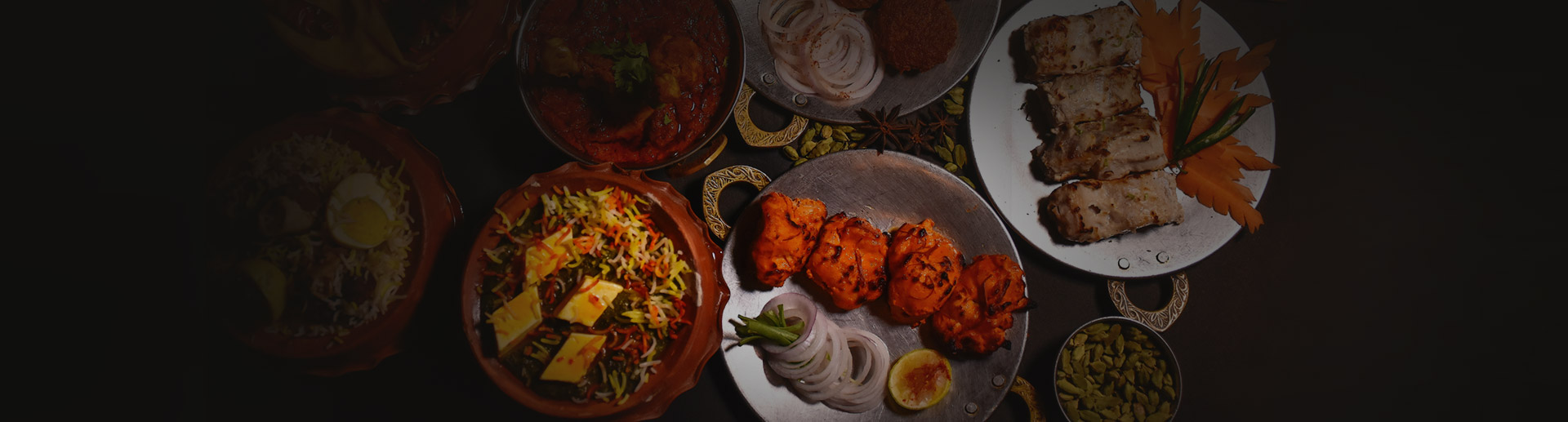
Royals embraced the 'Dum' style of cooking - a traditional technique of slow cooking rice, meat and vegetables in big cauldrons sealed off using dough and topped with flaming charcoal to cook the ingredients perfectly in their own juices.
The Dum style of cooking is believed to have originated during the rule of Nizam-Ul-Mulk, perhaps as a food-for-work program for thousands of workmen constructing.
To make a simple, one-dish meal for the workers, large cauldrons were filled with rice, meat, vegetables, and spices and sealed.
Legend has it that one day the Nawab caught a whiff of the aromas coming from these cauldrons and he ordered his royal kitchen to serve the dish.
The rest is history.